
For decades, policymakers have piled costs onto new housing and then wondered why housing costs so much. It’s a failure to understand basic supply and demand. Housing is expensive because (a) there isn’t enough of it, and (b) the renter/buyer ends up paying for delays, fees, and other requirements that drive up costs. What’s a locality to do?
Turns out, plenty of places have tested what happens when they make it easier to build. We have a decade or more of solid data to explore, should we care to look. Alternatively, we can quadruple down on the current thinking and hope for a different result.
Affordable Housing Policies in Charlottesville and Albemarle
Charlottesville recently overhauled its zoning and Development Code.1
Among the changes: in most of the city, any project of 10 or more units must make 10% of them affordable to a very affordable threshold.2 Those units lose a lot of money for the developer. By the city’s own math, each affordable rental unit is worth about $149,000 less than a market-rate one. Alternatively, a builder can pay around $338,000 (each) to not build affordable units.3
Albemarle County expects 20% of the homes in any rezoning to be affordable, up from 15% under its earlier policy.4 Affordable units are good, so these are good policies, right?
Here’s a simple explanation of what these affordable units actually cost.
Imagine 1,000 new homes coming to Charlottesville over the next decade. For our purposes, assume every project comes in multiples of 10, so 100 of the 1,000 are affordable. Where does that leave us?
We have 100 affordable units, which is great. We have 900 market-rate units that cost more than they otherwise would, because they are carrying the loss on the other 100. Not great. And what’s worse: the broader market follows new construction pricing. As people move to the area, prices trend upwards everywhere because new units are more expensive to build. So, the math isn’t 100 affordable units = 900 more expensive units. The entire market is more expensive in exchange for a mere 100 affordable units.
But what about greedy developers? Development is a business. Businesses run on math, and the math here is simple. It costs the same to build a unit whether it must be rented/sold well-below market rate or not. If 10% of units lose money, the other 90% are more expensive or the project does not work economically. In other words, the market-rate units make up the difference, or the deal doesn’t work and nothing gets built. And remember that housing is unaffordable because there isn’t enough of it. Nothing being built is terrible for affordability too.
This isn’t hypothetical. Portland, Oregon began requiring affordable units in nearly every apartment building over 20 units in 2017. Permit filings for apartment buildings fell 40% from their 2016 peak, and developers started designing around the rule.5
Charlottesville’s rule is too new to judge, but one early proposal under the new code, on Gordon Avenue, came in at nine units, one under the trigger.6
Albemarle has expected affordable units in rezonings for longer than Charlottesville, and it has tracked the results. By the county’s own count in 2015, about 1,200 affordable units had been promised through rezonings since its policy began in 2005, and roughly 100 had actually been built.7 Let me restate that in a shorter sentence. 1,200 units promised and 100 actually built.
Some of that gulf is the 2008 crash. But developers don’t spend $150,000 on a rezoning and then scuttle the project for fun. Affordability proffers come late in the rezone process. A project saddled with costly delays, expensive extra conditions, plus a condition that 15% (now it’s 20%) of the units lose money is not viable. Stated differently, the market-rate units would have to sell for well above market prices for the developer to get his money back out of the deal. So nothing is built.
So how are the affordable housing policies in Charlottesville and Albemarle working?
As someone who lives here, they don’t seem to be working as intended. Here’s a chart with actual data:8
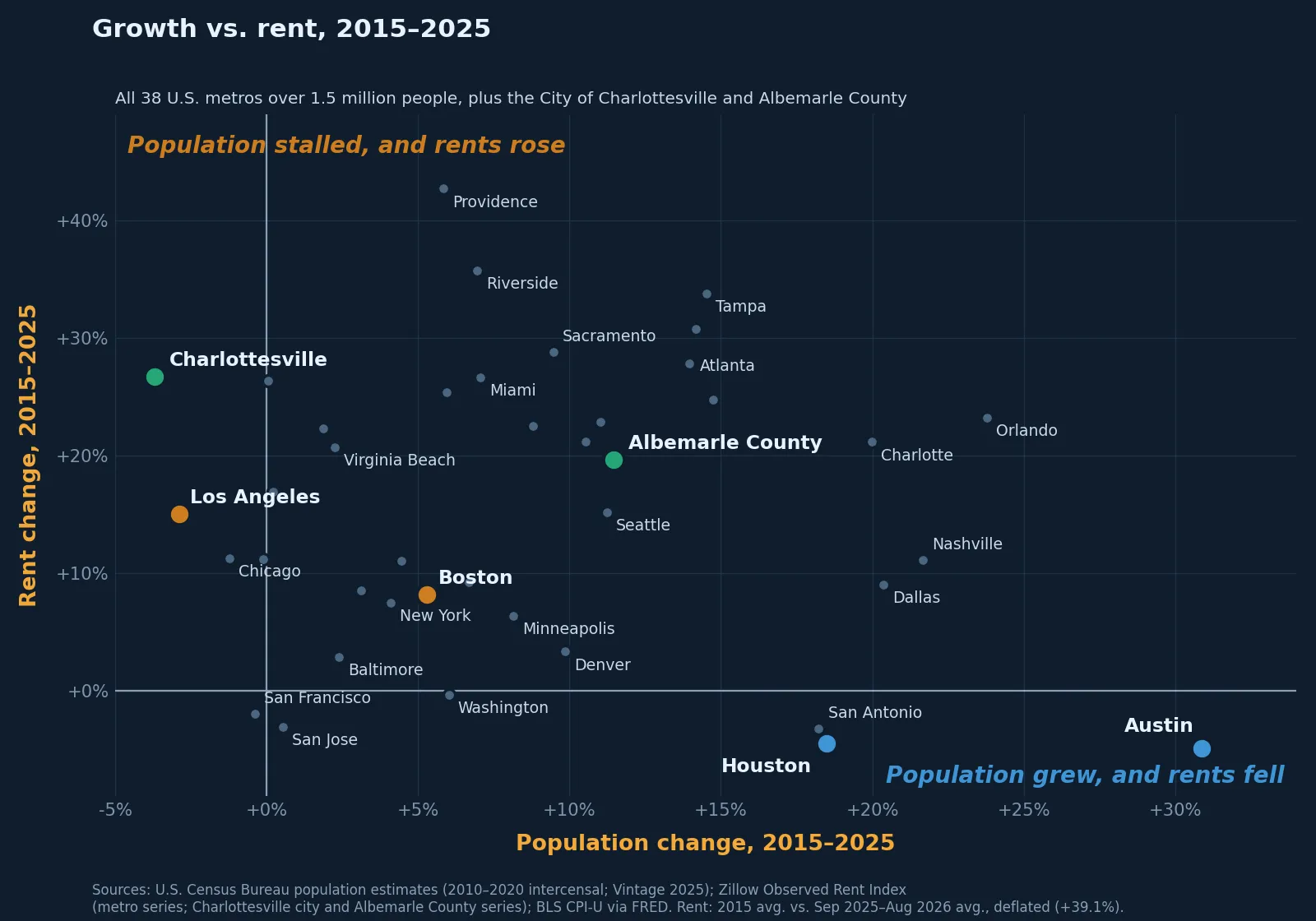
This chart shows rent growth on the vertical axis and population change on the horizontal axis, both over the last decade controlled for inflation. The gray dots are every U.S. metro area over 1.5 million people. Down and to the right is good: lots of new residents, falling rents. Up and to the left is bad. In fairness, Charlottesville has a large student population and should be read together with Albemarle. Combined, the two grew 6.9% while rents rose 22% after inflation.9 Still objectively terrible.
Charlottesville and Albemarle have very high rent growth compared to their population growth. To find an explanation, I looked at the housing policies of places ranging from Los Angeles to Boston, looking for places with a consistent approach over the last decade, and then compared them to places like Houston and Austin.
Two stand out as places with consistent policies we can study: Boston and Houston. Los Angeles’s housing policy is all over the place. Austin is much lauded for adding inventory recently, but its policies have been mixed if we take a longer view.10 But Boston and Houston have consistent policies we can explore.
So, what has Boston done to become so unaffordable? And what has Houston done to stay affordable?
Boston
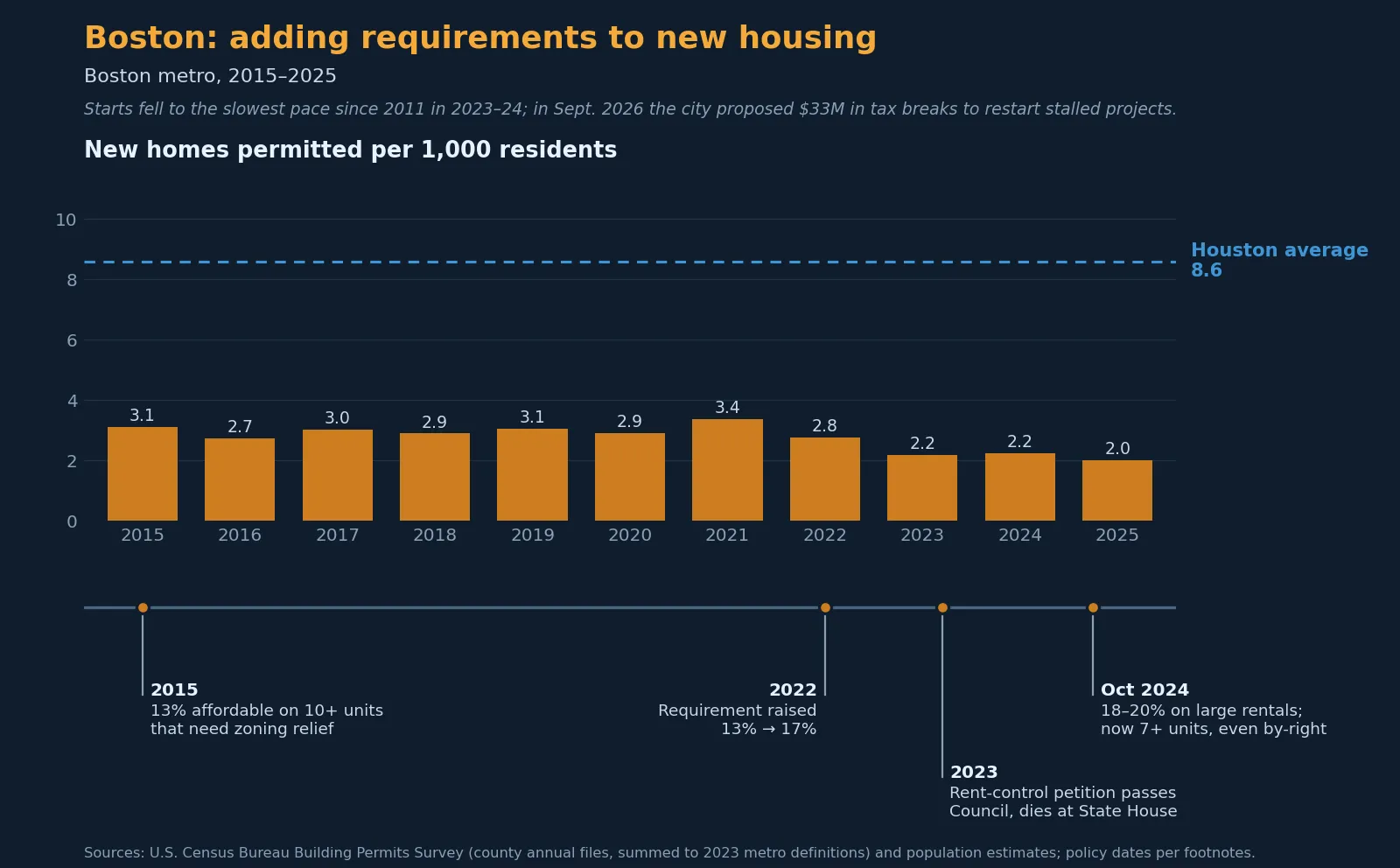
Boston has required affordable units in new buildings since 2000. In 2015 the rule was 13% of the units in any project of 10 or more that needed zoning relief.11 The rule held steady for years, and so did production: about three new homes per 1,000 residents a year, roughly a third of Houston’s pace.12
The policy wasn’t working as of 2022. How do you like them apples? Boston ordered another bushel and raised the affordability mandate to 17% of new units.13 In 2023 the City Council asked the state for the power to cap rents. The request went nowhere at the State House, and the statewide ban on rent control that voters approved in 1994 still stands.14 In October 2024 the requirement was written into the zoning code at 18–20% for large rental buildings, and extended to projects as small as seven units, even ones that need no zoning relief at all.15
Production fell off a cliff. Boston averaged about 4,250 housing starts a year from 2013 to 2022. In 2023 and 2024 it managed about 2,400 a year, the slowest pace since 2011.16 In September 2026 the city proposed $33 million in tax breaks to restart four stalled projects totaling about 1,400 apartments, with up to $100 million more for roughly a dozen others.17 In other words, the city is now paying developers to absorb the requirements it imposed.
In fairness, interest rates and construction costs rose everywhere after 2021, and Boston’s housing officials point to exactly that. But Houston faced the same rates and the same lumber prices. It kept building.
Houston
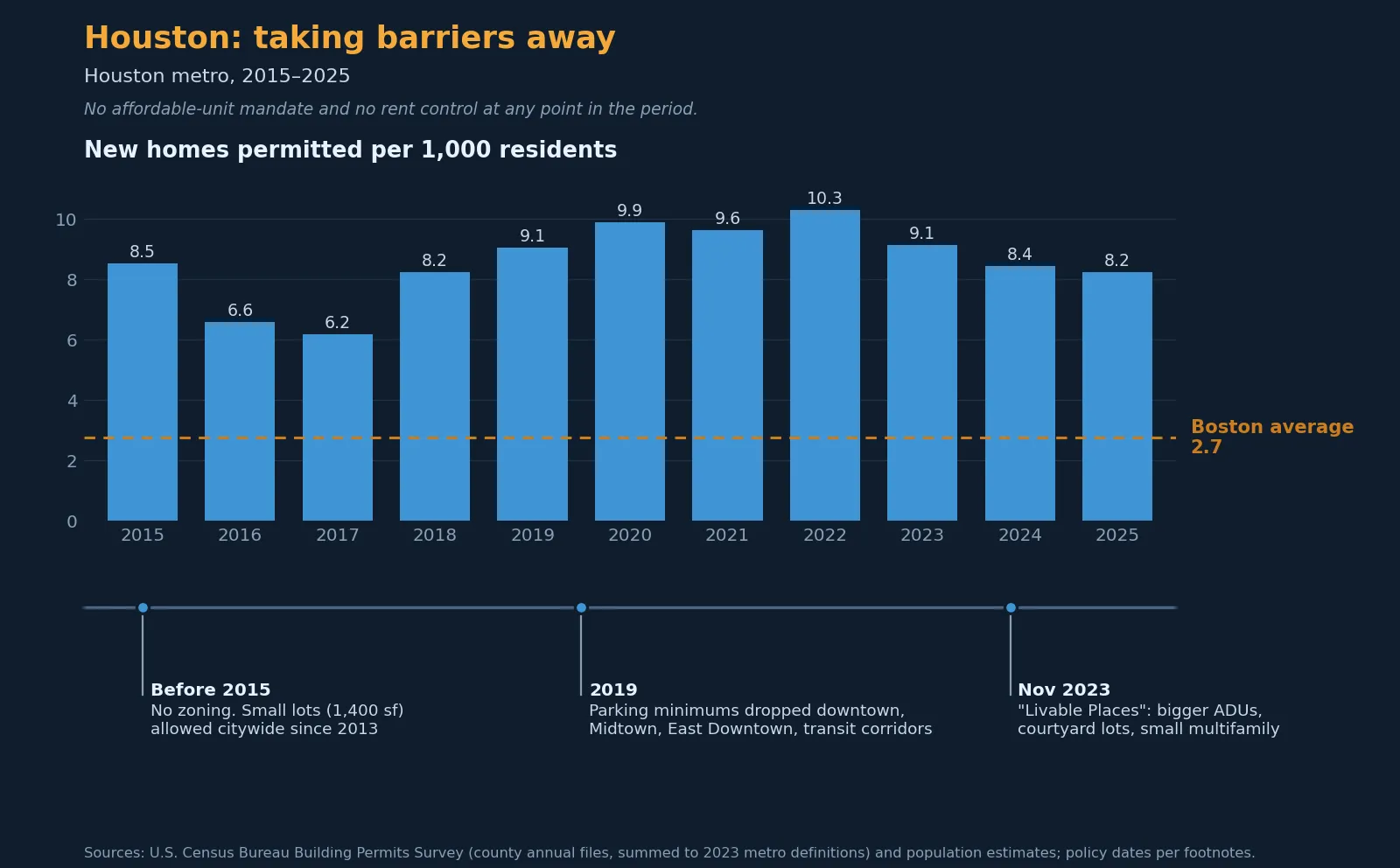
Houston is the largest American city without zoning. Voters love the lack of zoning. They turned down zoning: in 1948, 1962 and 1993.18 Houston’s freeways are lawless, but it’s not lawless from a development point of view. It has subdivision rules, lot size rules, and other rules it can use to control development. They don’t tell developers where they can put a house or gas station, but there are some rules. Many neighborhoods are also protected by private deed restrictions. But ultimately, the city doesn’t dictate what is built on a particular parcel. The market sorts that out, for better or worse.
Similarly, Houston has been steadily changing its development rules so that the free market yields more housing and more affordable housing. In 1998 it allowed homes on lots as small as 1,400 square feet inside the loop, and in 2013 it extended that citywide. Nearly 80,000 townhomes followed.19 In 2019 it dropped parking requirements downtown, in Midtown and East Downtown, and along major transit corridors.20 In 2023 its “Livable Places” changes allowed bigger backyard cottages, courtyard-style lots and small apartment buildings of three to eight units.21
What Houston never did: require affordable units or cap rents.
The result: the Houston metro permitted about 8.6 new homes per 1,000 residents a year, more than three times Boston’s rate.
In the last decade, Houston’s population grew 18.5%, and its rents fell 4.5% after inflation. Boston’s population grew 5.3%, and its rents increased 8.1% after inflation.22
What Charlottesville and Albemarle could do
Charlottesville is not Houston. I’m not suggesting it should be. But we can take a few lessons from Boston, Houston, and the thirty+ other metros on the chart above that show the same thing.
If we want affordable units, we should pay for them in the open. Tax abatements, fee waivers, and housing funds all work. Anything that lowers the cost of building works. Hiding the cost in everyone’s rent does not work. Even Portland got there. Its program now offsets developers’ costs, and a 2026 Oregon law requires Portland-area localities to fully offset what their mandates cost.23 How long will it take Charlottesville and Albemarle to understand this?
Streamline development. “Allowed” could mean allowed, not “let’s study this for six months.” Every hearing, study, and negotiation adds time. Time adds cost. Cost gets passed to tenants as rent. Delay makes housing more expensive. Period.
Keep shrinking the minimums: lot sizes, parking, setbacks. Houston’s small-lot rule alone produced nearly 80,000 townhomes.
And my personal favorite: modular housing. I love modular (not manufactured) housing. It’s so cheap to build, such good quality compared to cheap stick-built, and so easy for counties to inspect and permit.
Imagine an Albemarle County ordinance that allows modular (not manufactured) housing on small lots. Currently, every new unit in Albemarle pays roughly $18,000 to $19,000 in county development fees, the largest of which is water/sewer.24 I don’t know why Albemarle puts a $16,500 fee on water/sewer for every new house instead of spreading that cost across everyone’s water bill, but it could absolutely cut that fee for modular housing. Albemarle has inspection fees. A modular house arrives with the drywall up and inspection reports from the factory. It can just about be inspected from the truck.
I am not suggesting that we emulate Houston. I am suggesting that we skip a step. It’s cheaper to remove barriers to building new units than it is to put barriers in place, watch our policies fail, then subsidize housing to overcome the barriers we have raised. That’s the trajectory. Seems like an unnecessarily complicated way to lower housing costs, right?
What about the tradeoffs? What about our historic character? What if I want housing to be more expensive because I don’t like poor people?
The first two are fair points. Last point is a joke that hopefully landed.
The tradeoffs, however, are real and completely legitimate. Building many new houses when the roads and schools are already full is a problem. High density changes the character of places. Albemarle’s rural area is lovely. It’s part of our identity and probably a big reason people want to move here in the first place. But I have to ask: does a pocket neighborhood of modular (not mobile) houses on little lots, walkable to downtown Crozet, change that? Probably not. But, it definitely gives someone on a first-year teacher’s salary a place to live locally versus commuting from Greene or Augusta.
The point is not to give up what makes our community great. The point is to admit that the current policies in Charlottesville and Albemarle have made housing less affordable, not more. The current approach has a cost, and renters and buyers pay it, not developers. The “greedy developers should pay for affordable housing” mindset ignores the fundamental reality of any business. A business that operates at a loss goes out of business.
The current policies have demonstrably made housing less affordable. Which way are we headed?
On April 22, 2026, the Board voted 5–1 to raise county development fees, effective January 2027. Supervisor Sally Duncan voted no, saying: “You can’t make housing more affordable by driving up the costs.”25 She lost 5–1. Making homes more expensive to build makes housing more expensive. Other shocking revelations to follow.
Footnotes
-
The Development Code was adopted by City Council on December 18, 2023, and took effect February 19, 2024. City of Charlottesville, Affordable Dwelling Unit Monitoring and Procedures Manual, v1.2 (approved Feb. 5, 2024; updated Oct. 3, 2025), https://www.charlottesville.gov/DocumentCenter/View/14721. ↩
-
Charlottesville Development Code § 4.2.2 (applies to projects of 10 or more units outside the residential districts; the residential districts use a voluntary density bonus instead). Income level and 99-year term: ADU Manual § 2.4; Charlottesville Community Engagement, “Council briefed on affordability provisions in the Development Code” (Dec. 4, 2023), https://communityengagement.substack.com/p/december-4-2023-council-briefed-on. ↩
-
ADU Manual, Figures 1 and 2: average “value gap” of $149,025 per affordable rental unit; in-lieu fee of $337,648 per required rental unit ($395,869 per ownership unit), equal to the average total cost of developing a unit in Charlottesville. ↩
-
Albemarle County, Housing Albemarle (adopted July 7, 2021) (20% of units in rezonings and special use permits); Albemarle County Comprehensive Plan, ch. 9, Strategy 6b (adopted June 10, 2015) (15% under the County’s 2005 Affordable Housing Policy). ↩
-
Sightline Institute, “Portland’s Inclusionary Zoning Program Is Finally Performing, New Data Suggests” (Nov. 25, 2025), https://www.sightline.org/2025/11/25/portlands-inclusionary-zoning-program-is-finally-performing-new-data-suggests/; City Observatory, “Inclusionary Zoning: Portland’s Wile E. Coyote moment has arrived” (Mar. 9, 2021), https://cityobservatory.org/inclusionary-zoning-portlands-wile-e-coyote-moment-has-arrived/. ↩
-
Charlottesville Community Engagement, “Look Back 2024 Part Six: Affordable Housing and Charlottesville’s new development code,” https://communityengagement.substack.com/p/look-back-2024-part-six-affordable (1609 Gordon Avenue, nine units). ↩
-
Albemarle County Comprehensive Plan, ch. 9 (Housing), p. 9.11 (adopted June 10, 2015). ↩
-
The vertical axis is the change in asking rent after inflation, from the 2015 average to the average of the last twelve months (September 2025 through August 2026). The horizontal axis is population change from July 2015 to July 2025. ↩
-
Population: U.S. Census Bureau estimates for July 1, 2015 (2010–2020 intercensal series) and July 1, 2025 (Vintage 2025). Rents: Zillow Observed Rent Index, 2015 average vs. September 2025–August 2026 average, adjusted for inflation with the BLS Consumer Price Index (CPI-U, up 39.1% over the period). Charlottesville alone: population −3.7%, rent +26.7%. Albemarle alone: population +11.5%, rent +19.6%. Combined rent weighted by renter households (American Community Survey, 2020–2024). ↩
-
Austin spent five years and $8.5 million on a code rewrite (CodeNEXT) that City Council abandoned in 2018; its major reforms, including eliminating parking minimums and the HOME initiative, came in 2023–2024. Bloomberg, “Austin Rents Tumble 22% From Peak on Massive Home Building Spree,” https://www.yahoo.com/news/austin-rents-tumble-22-peak-130017907.html; Pew Charitable Trusts, “Austin’s Surge of New Housing Construction Drove Down Rents” (Mar. 18, 2026). ↩
-
National Law Review, “Boston Adds Updated Inclusionary Development Policy to the Zoning Code—What Questions Remain?,” https://natlawreview.com/article/boston-adds-updated-inclusionary-development-policy-zoning-code-what-questions. ↩
-
U.S. Census Bureau, Building Permits Survey, county annual files 2015–2025, summed to metro areas; population from Census Bureau estimates. Boston metro: 2.7 homes permitted per 1,000 residents per year; Houston metro: 8.6. ↩
-
Boston Globe, “Amid housing crisis, Boston’s building boom has gone cold. How much of that is due to Mayor Wu?” (June 30, 2025), https://www.bostonglobe.com/2025/06/30/business/boston-housing-construction-policy-affordable-housing/. ↩
-
WBUR, “Boston City Council approves rent control proposal” (Mar. 8, 2023), https://www.wbur.org/news/2023/03/08/boston-city-council-approves-rent-control-proposal; Mintz, “SJC Blocks Rent-Control Initiative from 2026 Ballot” (June 23, 2026), https://www.mintz.com/insights-center/viewpoints/2026-06-23-sjc-blocks-rent-control-initiative-2026-ballot-massachusettss. ↩
-
Boston Zoning Code Article 79, effective October 1, 2024. National Law Review, supra. ↩
-
Boston Globe (June 30, 2025), supra. ↩
-
Banker & Tradesman, “Wu’s Tax Breaks Not Enough to Restart Housing, Critics Say” (Sept. 2026), https://bankerandtradesman.com/wus-tax-breaks-not-enough-to-restart-housing-critics-say/. ↩
-
Works in Progress, “Houston, we have a solution,” https://worksinprogress.co/issue/houston-we-have-a-solution/. ↩
-
Mercatus Center, “Learning from Houston’s Townhouse Reforms,” https://www.mercatus.org/research/policy-briefs/learning-houstons-townhouse-reforms; Works in Progress, supra (citing Emily Hamilton’s estimate of almost 80,000 townhomes). ↩
-
Houston Ordinance 2019-0540. Parking Reform Network, “Parking reforms in Houston, Texas,” https://parkingreform.org/mandates-map/city_detail/Houston_TX.html. ↩
-
Effective November 27, 2023. Houston Public Media, “Houston amends residential development requirements to promote walkability, affordable housing expansion” (Sept. 28, 2023). ↩
-
Permits: see note on Boston production above. Population and rents: same sources and method as the chart. ↩
-
Rental Housing Journal, “Nearly a Decade of Inclusionary Zoning: What Portland’s Experiment Actually Produced” (June 8, 2026), https://rentalhousingjournal.com/nearly-a-decade-of-inclusionary-zoning-what-portlands-experiment-actually-produced/ (2024 recalibration; Senate Bill 1521, signed Mar. 31, 2026). ↩
-
Albemarle County Service Authority connection charges per residential unit (ACSA system development charges plus Rivanna Water and Sewer Authority capacity charges): $15,000 in FY2026, rising to $16,500 under the FY2027 budget. C-VILLE Weekly, “Albemarle supervisors to update guidelines for use of housing funds, with $7M slated for next fiscal year” (May 27, 2026), https://c-ville.com/albemarle-supervisors-to-update-guidelines-for-use-of-housing-funds-with-7m-slated-for-next-fiscal-year/. The component charges reported in Charlottesville Community Engagement, “Albemarle County Service Authority to increase water and sewer connection fees in FY2027” (May 26, 2026), https://communityengagement.substack.com/p/may-26-2026-albemarle-county-service, sum to $16,100. County permitting adds roughly $1,300 to $2,300 for a typical house: a tiered single-family building permit fee of $500 to $4,000 by dwelling size, a $60 zoning clearance, a $25 zoning inspection, and a $235 VESMP land-disturbance permit. Albemarle County, Community Development Fees. Installation and other site-specific charges are additional. ↩
-
Albemarle Cnty. Bd. of Supervisors, fee schedule ordinance (adopted Apr. 22, 2026; effective Jan. 2027) (cost-of-living adjustments since FY2022; vote deferred from Apr. 15, 2026). CitizenPortal, “Board approves updated fee schedule; one dissenting vote on development fee increase,” https://citizenportal.ai/articles/9696403/Virginia/Albemarle-County/Board-approves-updated-fee-schedule-one-dissenting-vote-on-development-fee-increase. ↩